Castiglione d'Orcia
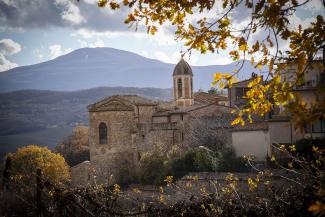
“Frate Raimondo e frate Tommaso e Monna Tomma e Lisa e io siamo alla Rocca, fra mascalzoni; e mangiansi tanti dimoni incarnati, che frate Tommaso dice che gli duole lo stomaco. E con tutto questo non si può saziare”.
(dalle lettere di Santa Caterina da Siena dalla dimora presso la Rocca di Tentennano)
Castiglione d’Orcia and Campiglia d’Orcia, two of the three main towns of this municipality, face the splendid Val d’Orcia and offer to the eye the wonders of a landscape declared a UNESCO World Heritage Site. The third village, Vivo d’Orcia, situated at the feet of Monte Amiata, lies completely surrounded by chestnut woods with its fresh and precious waters. A journey capable of uniting these three villages, without skipping the warm waters of Bagni San Filippo, is a great escape from time to enjoy not only the naturalistic beauties but also the presence of unexpected historical and artistic testimonies.
Castiglione d'Orcia, was for centuries a stronghold of the Aldobrandeschi and was later long contested by Siena and the Salimbeni family for its strategic position on the Via Francigena. The Rocca Aldobrandesca and the impressive Rocca di Tentennano, overlooking the small medieval town of Rocca d’Orcia, constitute two distinctive features of a very flourishing and strong past. The same goes for Campiglia d’Orcia, a charming, early medieval settlement long dominated by the Visconti family; the remains of Rocca Viscontea di Campigliola bear witness to their importance.
The strong local population is made of lumberjacks, hunters and farmers “geusque virum trucis ed duro robore nata” (a lineage of men born from the trunks of hard oak). Today, these people cultivate the memory and tradition that find in the propitiatory songs of May one of their most beautiful representations. Magic lies in Vivo d'Orcia where the fresh, pure waters of the Ermicciolo spring flow from the rock, with the evocative 80 meter tunnel from which the historic Acquedotto del Vivo comes to life. Magic is also found in the Romanic church of San Benedetto all’Ermicciolo, the Eremo dal Vivo founded by San Romualdo in the year one thousand. Cardinal Marcello Cervini, who later became Pope Marcellus II, is responsible for the construction of the famous Palazzo Cervini on the remains of the monastery.
Finally, downstream is Bagni San Filippo, an ancient thermal area famous for the presence of the spectacular limestone deposits of the “Balena Bianca”.
www.visittuscany.com www.visitvaldorcia.it | www.valdorciapatrimoniomondiale.it
This Hub's iconic routes are the “Grand Tour Val d’Orcia Patrimonio Mondiale” and the “Grand Tour Val d’Orcia Paesaggio Culturale Gravel”. Both allow one to explore the territory and its most hidden corners. The “Via Francigena” routes are also of great interest, in particular the Amiata variant that in part follows the historical trail path. The gravel route that leads from the cool waters of the Vivo to the thermal area of the Bagni San Filippo, “Il Vivo e la Balena Bianca tour” is also one of exclusive charm.