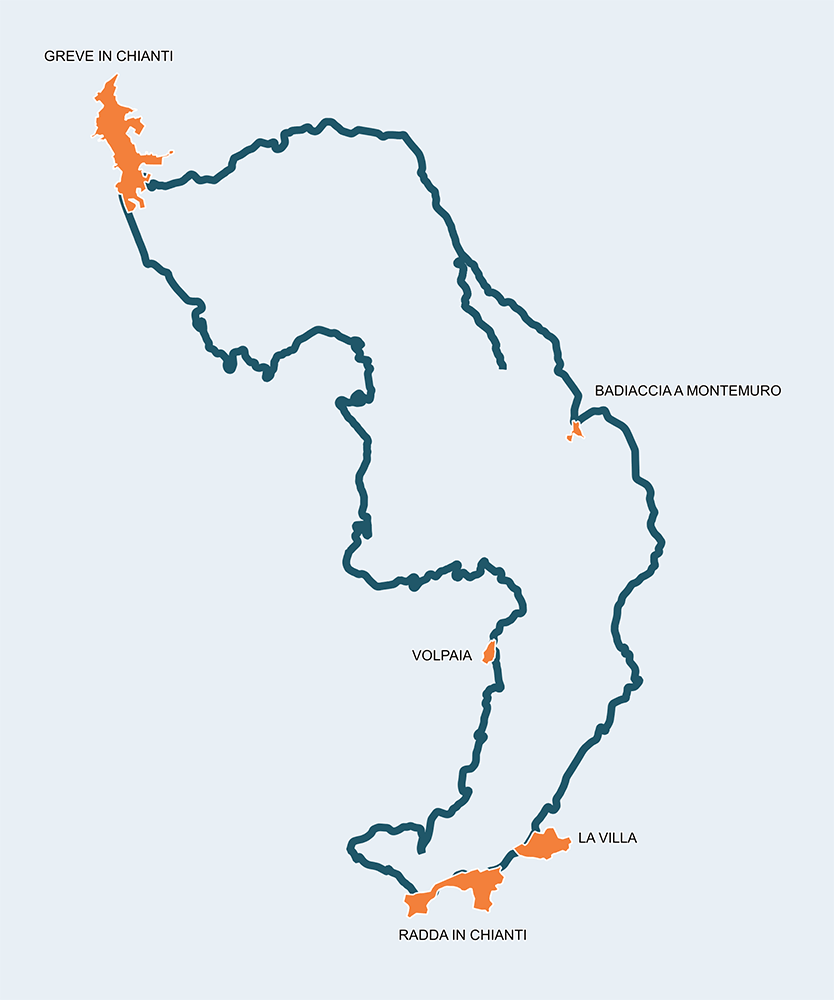
Greve in Chianti – Radda in Chianti
Difficult
The third and last stage of this trip gets difficult again. After leaving Greve you take the secondary road of Barbiano and deviate towards Via Petriolo, in Lamole’s direction. The road is beautiful, solitary and paved: vineyards, dry stone walls and cypresses accompany the cyclist towards his destination, even if along the path, the chances of taking a detour in one of dirt roads leading to farmhouses and cottages with open cellars are plenty. You enter the “Historical Rural Landscape of Lamole”, where the farmer is also a good architect. After the small church of Casole you get to Lamole, where you can enjoy a meal and a breathtaking view. After leaving Lamole the white road goes up with accessible slopes towards the summit. The vineyards slowly grow distant and the forest comes back to dominate the landscape of this side of Monti del Chianti. After reaching the wooded summit you start descending again and the vineyards come back to delight the view, until reaching the authentic town of Volpaia, still conserving most of its ancient defensive walls and the ruins of a medieval castle. A stop here is mandatory, since drinks and fine food to accompany the rest of the "warrior" are plenty. You descend, accompanied by a landscape matching Lamole’s suggestions, until reaching the SR429 road where you go to look, deceived by the favorable slopes, the SC8 of Campassole that in just 1 km and 300 meters records a good 148 meters of difference in altitude with an average slope of 11%. The place commonly known as “Furnace Creek” is often chosen by sadistic aspirants who, perched up the hill, love to address the cyclist with the Italian saying: "You wanted a bike? Now use it!". It is essential to ignore the provocations and not get caught by the discouragement because Radda is close and, arriving at the top of the slope with just another kilometer, in a climb that almost appears as a descent, you reach the Fiorentina door and then the historical centre. Perhaps a short visit to the fifteenth century wooden crucifix housed in the church of San Niccolò would be appropriate.